
The Smoky Mountain real estate market is heading into the busy spring season with renewed momentum. From rising inventory to shifting short-term rental (STR) performance, March 2026 offers valuable insights for investors. Here’s a detailed look at the latest STR and sales data in the Smoky Mountains region:
March 2026 Sales Stats

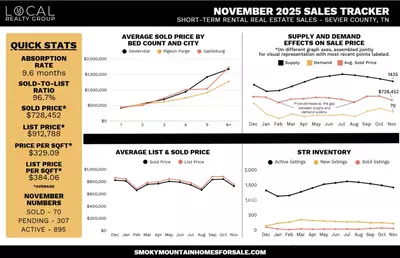
March 2026 numbers reflect a stabilizing market with steady activity:
- Absorption rate: 9.18
- Sold-to-list ratio: 95.47%
- Average sold price: $731,492
- Average list price: $766,516
- Average price per sq ft: $359.15
- Average list price per sq ft: $376.21
- Sold: 59
- Pending: 286
- Active: 1,050
Smoky Mountain real estate is still selling close to asking price, but buyers are gaining a bit more leverage compared to recent years. With over 1,000 active listings and strong pending activity, the market remains competitive yet balanced.
Supply & Demand Trends
Inventory and sales activity reveal import seasonal patterns. Throughout 2025, inventory climbed steadily, peaking at 1,641 active listings in July before gradually declining toward the end of the year. As of March 2026, inventory has rebounded to 1,420 active listings, alongside 497 new listings (a significant monthly increase) and 59 sold listings (up from February’s 42). This cycle reflects key seasonal trends in Smoky Mountain real estate:
- Winter: Slower activity, fewer sales
- Spring: Inventory and buyer interest rise
- Summer: Peak demand and pricing strength
Average Sold Price by Bed Count & City

Smoky Mountain real estate pricing continues to vary based on both location and property size. In Sevierville, Pigeon Forge, and Gatlinburg, larger cabins command significantly higher prices. Gatlinburg leads in pricing for mid-size properties, while Sevierville commands top value in larger cabins.
Sevierville:
- 1 Bed: $438,819
- 2 Bed: $520,225
- 3 Bed: $676,409
- 4 Bed: $887,403
- 5 Bed: $1,500,131
- 6+ Bed: $1,724,797
Pigeon Forge:
- 1 Bed: $422,770
- 2 Bed: $491,733
- 3 Bed: $575,854
- 4 Bed: $845,383
- 5 Bed: $1,106,500
- 6+ Bed: $1,375,000
Gatlinburg:
- 1 Bed: $439,611
- 2 Bed: $551,787
- 3 Bed: $741,436
- 4 Bed: $1,016,559
- 5 Bed: $1,184,390
- 6+ Bed: $1,687,375
STR Market Performance
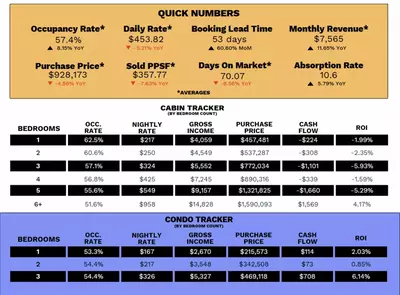
The short-term rental market remains a major force behind property values in the Smoky Mountains. Here’s an overview of STR performance in March 2026:
- Average occupancy rate: 41.9%
- Average daily rate: $321
- Booking lead time: 47 days
- Average monthly revenue: $4,300
- Average purchase price: $731,492
- Average sold price per sq ft: $359.15
- Average days on market: 185
- Absorption rate: 9.18 months
Along with increasing inventory and new listings, this signals that more STR investors are entering the market ahead of peak travel season. It’s also important to note that occupancy rates and returns vary significantly based on property size, amenities, and management strategy.
Cabin Performance by Size

The March 2026 data reveals important insights into Smoky Mountain cabin performance. Larger cabins produce significantly higher income, driven primarily by a higher ADR, which climbs from $229 for 1-bedroom cabins to $936 for 6+ bedrooms. These higher earnings are offset by substantially higher purchase prices and operating costs. All cabin sizes currently show negative ROI, though this tends to improve as cabin size increases. This suggests that while larger properties require more capital, they are also more efficient at generating income relative to their cost.
4+ bedroom cabins appear to offer the best potential, with strong ADR ($499 to $936), higher gross monthly income ($5,089.80 to $8,985.60), and better ROI compared to smaller units. These properties strike a balance between affordability, revenue potential, and broad appeal for families and group travelers. Smaller cabins have lower risk, but they also tend to have lower returns.
Another notable takeaway is that occupancy rates remain relatively consistent across cabin sizes, ranging from 32% to 37%. This tells us that larger cabins are not necessarily booked more often; instead, they earn more because of higher nightly rates. This shows investors that buying a larger cabin doesn’t guarantee more bookings. Success depends heavily on marketing, amenities, and guest experience.
What This Means for Buyers & Sellers
For Buyers:
With rising inventory and more new listings hitting the market, buyers have increased options and negotiating power. This is an ideal time to secure a Smoky Mountain real estate property before peak summer demand drives prices higher.
For Sellers:
Pricing correctly is critical. While demand is improving, today’s buyers tend to be more data-driven and selective. Well-priced and well-marketed cabins, especially those optimized for STR performance, are still selling quickly.
Invest in Smoky Mountain Real Estate
The March 2026 data shows a market in transition, balancing increased inventory with steady demand and long-term investment potential. For those willing to take a strategic approach, Smoky Mountain real estate continues to offer strong opportunities for experienced and first-time investors.
If you’re looking to invest in a short-term rental property in the Smokies, understanding these trends can help you make confident, informed decisions. Are you ready to get started? Connect with a local expert at Local Realty Group to explore your options and maximize your success in the Smoky Mountain market!